RBC Fraud Investigation Training: Design Analysis
phase iii of a team design project for cps412: an ai-assisted training system for newly hired rbc fraud investigation staff. the full report follows.
Abstract / Introduction
Our client has provided a set of requirements that must be fulfilled to ensure a design that thoroughly satisfies the needs of each employee and maximize their work throughput with minimal assistance from senior staff. The overall age range of employees is varied greatly and includes people from a diverse array of backgrounds. Thus, it is imperative that accessibility and usability implementations are designed in a way that accommodate their specific needs to provide a seamless user experience. Apart from having a "dated" organization scheme, text-based resources are available for employees to review but lack evaluation modules or simulated scenarios. An updated design would require an interface overhaul and the inclusion of existing learning resources with modules that provide practice scenarios that reflect real-world cases. As the investigations team handles sensitive personal and banking data, certain measures are required to maintain client confidentiality. Certain security protocols are also required to protect sensitive employee information. Potential design choices must consider existing authentication protocols and level access.
Accessibility Requirements
The age range of employees in the investigations team is diverse, ranging between 20 and 70 with most over the age of 50. Our client has stated the latter having inadequate software experience; often facing difficulties in navigating the UI and discerning interface elements, requiring consistent assistance from other staff or the IT department. With a diverse range of employee backgrounds, an adequate design requires that individual needs are satisfied to ensure a seamless experience for all employees that minimizes the need for assistance.
The list of all accessibility requirements is as follows:
- Graphical elements (fonts, hyperlinks, buttons, etc.) must be re-resizable individually or globally.
- UI contrast must be user-customizable and promoted on first run.
- Comprehensive first-time-run tutorial and accessibility settings prompt for the user.
- Tutorial/guide must always be available for review purposes.
- First-run assessment of accessibility needs.
- Comprehensive software tips during use.
- An AI implementation may serve as an on-demand guide.
- Any AI implementations must be intuitive, straightforward to use, and provide a dedicated tutorial on the general usage of artificial intelligence.
- The system must conform to the learning style of the user.
Resource Requirements
The primary method of learning work duties is through observation during limited training sessions with senior employees. As stated by our client, resources are available for staff to acquire and review information that is needed for their role. Currently, Investigations employees utilize a platform called "Connect Portal" to access these resources that contain summarized notes taken during training sessions and textbook-style sections that go into excruciating detail regarding everything a staff member would need to know to deal with investigations cases and how the proprietary software functions. Issues have been brought to our attention such as the lack of problem sets for individual sections or any form of evaluation on acquired knowledge, and the "dated" and confusing organization scheme of the resource portal which makes finding specific information cumbersome. Employees are required to refer to senior staff or the IT department to have any questions regarding investigation details or software functionality answered which increases the time needed to complete tasks. Due to the comprehensive nature of the textbook-style resource, it is deemed an ineffective resource to refer to while processing investigation cases due to potential time losses. As such, the design and structure of the system is inadequate in training new employees.
Designing software that mitigates these issues must satisfy the requirements below:
- Intuitive resource navigation.
- AI-assisted navigation.
- Available globally across all sections.
- Existing resources must be consolidated into the system with included practice scenarios and tailored feedback.
- Dynamic feedback and problem set distribution.
- AI must be able to fetch and summarize information accurately when prompted by the user whether for learning or review purposes.
- Real-world client scenarios may be included to form accurate problem scenarios.
Security Requirements
Client and staff privacy and confidentiality are held in high regard at RBC. Thus, the investigations team is responsible for ensuring that authorization clearance is provided only to employees of the team. This is to ensure that client data is not mishandled and kept safe from unintended uses. Access to case files and client data is locked behind a set of login prompts that are assigned to an investigation employee's personal account and login details. This means that if someone were to acquire these login details, they would have direct access to personal client information and the account holder's personal information. RBC resources available to investigation employees would also become visible to the unauthorized user and have the potential to be exploited. As all software used by investigations employees share universal login credentials, it is expected that our solution would implement this behaviour.
Below are the requirements needed to satisfy our client's security expectations:
- Implementation of existing security protocols.
- Existing login credentials are used to access a virtual private network (VPN) which allows authorized users, on-site and off-site, to access RBC databases and software (RSA Token Two-Factor Authentication is used to authorize users).
- Solution must be compatible with RSA Token.
- Encryption of local user account and sample data.
- Logs and personalized information/settings must be encrypted to prevent unauthorized access/snooping.
- Sample data of RBC clients may be used to improve our solution's ability to produce user evaluation feedback.
- Propagate collection disclaimers to investigations staff and clients.
- Anonymization of client data.
Proposed Solution
The Client's current training system is heavily reliant on the company's senior employees as trainers of new staff. This could be identified as an issue because the senior employees who are crucial to the company now are forced to increase their workload which could detriment their own output. They are expected to remove their attention from their work and productivity flow to take on trainees.
Regarding the fraud detection, we were able to come up with a solution for the agent.
Who are our users: Recently hired RBC fraud investigation unit staff.
The company works on a credit-based performance system which means employees must complete a day by day quota of 47 credits. Because of the new responsibilities of training new employees, the seniors are finding it difficult to reach the quota. The inability to reach the quota directly affects the employees pay. Also, new employees are not fully ready after training as the client has mentioned.
Current New hire Training Methods:
- Text based learning resource / Textbook
- On the job training with guidance from senior staff
Challenges of Current Training Methods:
- Textbook is unable to provide engaging/interactive scenario based education
- No alternative methods for new hires to gain experience without real working situation
- Guidance in the training from Senior staff disruption in team work flow.
Current training process leads to:
- Proprietary software navigation
- Fraud indication detections
- Data entry accuracy
This means higher rates of error and needs multiple higher up staff to look over and fix. Slowing down productivity even more overall.
Proposed Solution
Learning from the current textbook is not the optimal training study method, we can convert the information on the textbook into an interactive online education portal with built in AI generated practice and mock data to practice on.
- Online Education portal based on the existing textbook. Including AI generated practice problems with a simulator/playground with a real life scenario, simulation with dashboards and fake accounts monitoring to test staff ability to identify fraud
Core Features:
- AI generated practice problems replicating real life scenarios, providing exposure to a variety of fraud types and immediate feedback after mistakes.
- Simulation environment with simulated dashboards, fake accounts and transactions, providing the opportunity to apply what was learned in and practice freely without real world implications
- Account login system and Performance dashboard to help track the progress and accuracy during training and provide detailed feedback on areas of improvement. (Trainees should need to consent to having their training progress tracked)
- Simple UI/UX, clear instructions
- Trainees who are less 'tech-savvy' should not suffer
- Need to support them with built-in optional walkthroughs of the basics of the software
Technical Specification:
- Java / MySQL
Software Architecture
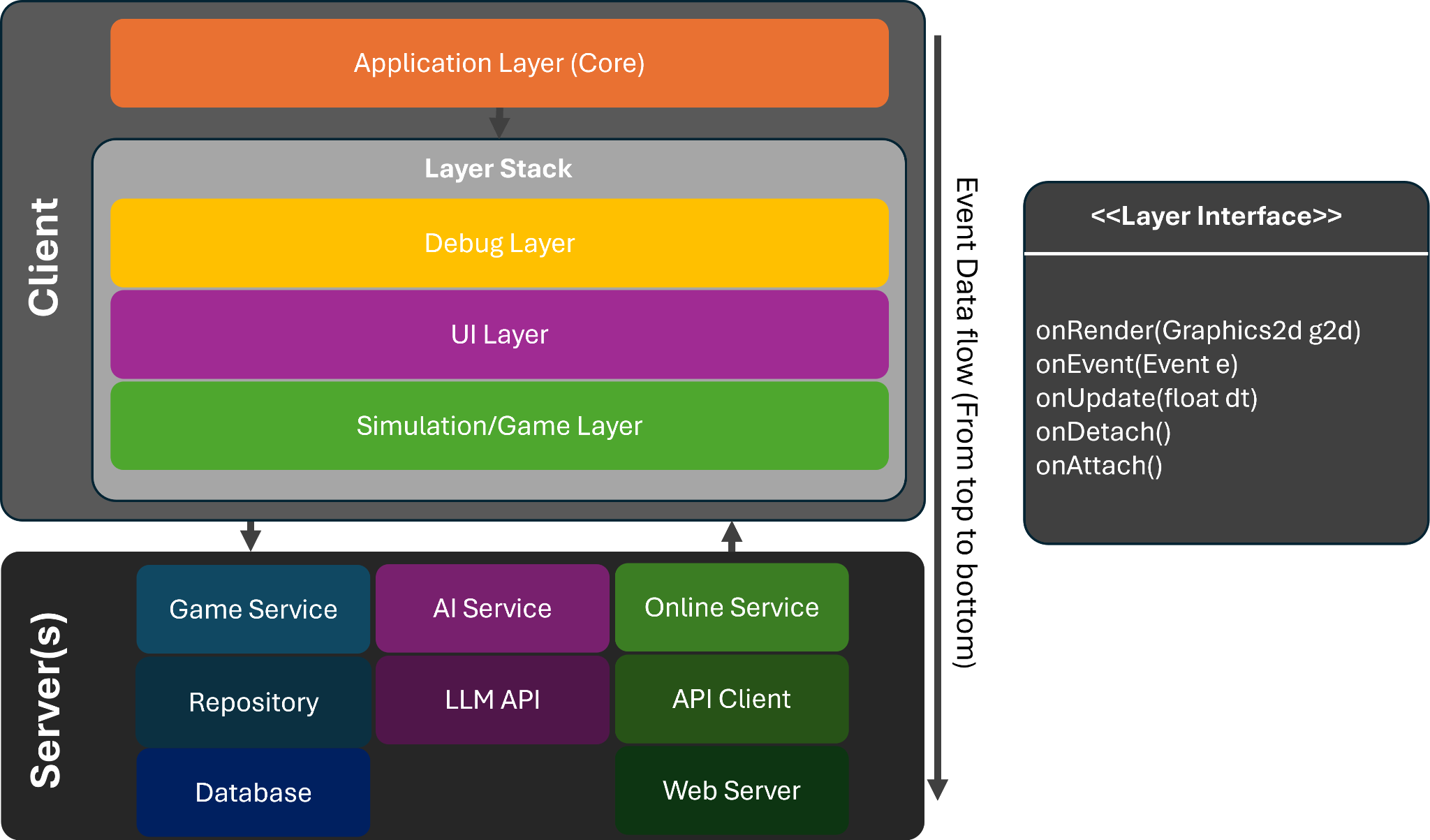
The software architecture chosen for this project is a hybrid of layered and client-server architectures. Each
client runs the simulation locally on their machine, while the game communicates with external services, such as
databases and large language models (LLMs), to provide additional functionality. In this sense, the application
acts as a client, and these external systems act as servers. At the core of the application is the Application
Core, which contains the main simulation/game loop. This loop runs continuously and updates every frame,
propagating control through the layer stack. It consists of three primary functions: onUpdate(),
onRender(), and onEvent(). The onUpdate() function handles changes to game state
(such as player position), onRender() is responsible for drawing elements to the screen, and
onEvent() distributes events throughout the system. Events are propagated using the observer pattern,
allowing any layer that is subscribed to a given event to respond accordingly.
The layer stack is designed to be modular, with each layer loosely coupled to the others. This improves maintainability and allows future developers to modify or extend individual layers without impacting the rest of the system. As shown in Figure 1, the stack consists of three primary layers: the Simulation/Game Layer, the UI Layer, and the Debug Layer. Rendering occurs from bottom to top, meaning the UI is drawn over the game layer, and debug information is rendered on top of both. The Game Layer is also responsible for interacting with systems outside the layer stack. These external services are not included within the stack because they do not need to be updated every frame and operate independently of the rendering cycle. This separation establishes a clear boundary between the client (the application and its layers) and the server-side components (external services). When the Game Layer needs to access external functionality, such as querying an LLM, it does so through dedicated service classes. For example, requests to an LLM are handled by an AI Service, which acts as a mediator between the game and the external API. This service formats requests, manages communication, and returns results in a way that fits the needs of the game. This design enforces a strong separation of concerns and prevents the Game Layer from becoming overly complex or taking on too many responsibilities.
Finally, this architecture relies primarily on composition rather than inheritance. Composition is preferred in this context because it allows for more flexible and modular design, where classes define behavior through contained components rather than rigid hierarchies. This is particularly well-suited for game development, where objects often require dynamic and varied functionality. However, inheritance is still used where appropriate, particularly in the UI system, where shared structure and behavior make it difficult to avoid.
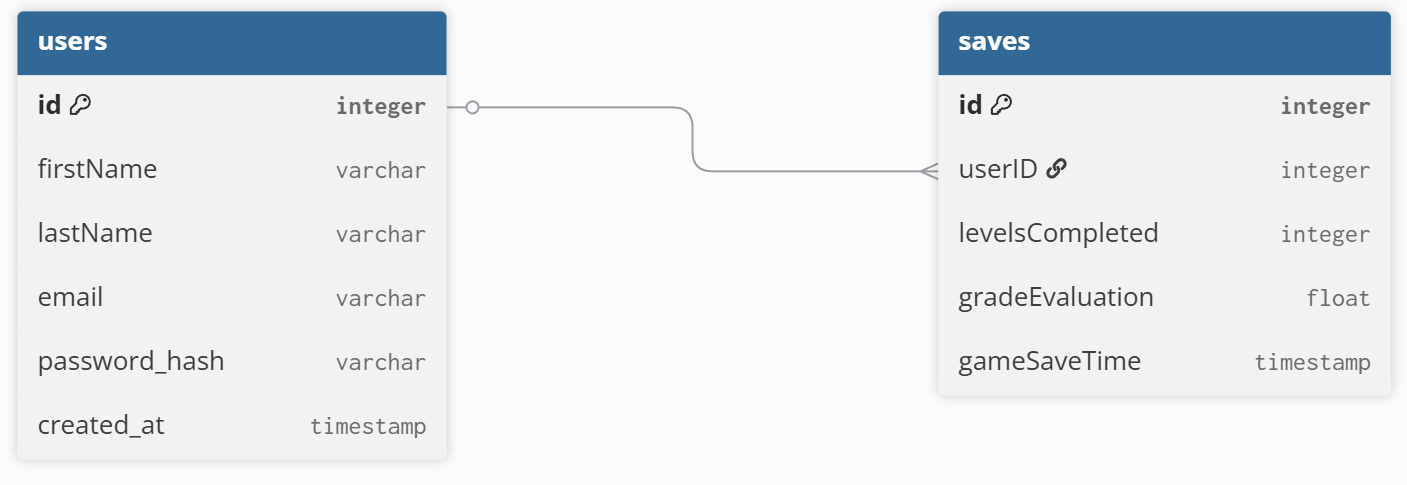
Figure 2 illustrates a basic database schema used in this project. The database is designed to store only essential information required by external services, such as the AI service, while frequently changing data, like player position, is stored locally on the client. This approach improves performance by enabling fast lookups and allowing external services to access data without involving the game layer directly. It also supports efficient caching when needed. The schema consists of two tables: users and saves. These tables store information about users/trainees, allowing managers or other systems to evaluate their progress. The users table contains account-related data, while the saves table tracks each user's progress over time. The saves table references the unique ID assigned to each user, ensuring that every saved game state is correctly associated with the corresponding trainee. This relationship allows external systems, such as the online portal, to retrieve and analyze user-specific data efficiently.
Privacy Analysis
Our current proposed Training Simulation for RBC Banking's fraud investigation lacks adequate privacy measures in its design elements. Also introducing significant risks that must be managed. Overall, the system shows that there was an attempt to design with security in mind but its addition of AI driven features create potential for future issues and we will need to implement measures to alleviate that.
On a positive note, the design keeps data protection and controlled access at the top priority. We use the existing RBC authentication tools such as already existing RBC VPNs and RSA 2FA. This means the software uses preexisting trusted security rather than us implementing brand new untested infrastructure that will overcomplicate the development process and testing. Also using native features streamlines the security process. Additionally, we encrypt local user data, logs and stored information, this will lower the risk of unauthorized access to the system. We use anonymous mock client data which is one of the most important parts, it lowers exposure of personal information while still letting trainees practice with realistic scenarios. Finally, the program asks for the user's consent before tracking performance. This aligns with ethical data collection practices.
Although, the several privacy concerns come from the AI use and data processing. The addition of LLMs introduces issues as to how the data is processed and stored. If sensitive data or simulation information is shared by the AI to external APIs, that poses a risk of data leaking. Another weakness is in the storage of user performance data and behavioural data, while it is used for evaluation and is important, it creates a log of employee's work ethic, habits and most importantly, weak points. This information in the hands of someone with malicious intent can use it to infiltrate the security systems. Also this data could be misused by senior employees to unfairly assess trainees or use it outside of the training simulation. Additionally, the system has a vulnerability in its reliance on single credential sets. If the login credentials are leaked or hacked, an attacker could get access to the data and training simulation.
There are risks related to the usability features such as the AI guidance chatbot, it may perform actions that we do not want it to and could over collect data on users that we do not want to collect. This would violate ethical principles.
In conclusion, the design is strong and has a good foundation for security with encryption, authentication and the use of mock data. We must further take measures to lessen the risk in data collection, login security and AI integration. This will further strengthen the policies and limit unauthorized access to the data. This would improve the training simulation and would help ensure confidence from RBC after testing and deployment.
Security Analysis
This section is broken down into three parts: Strengths, Weaknesses and Recommendations.
Strengths
Overall, the architecture of this system is well designed. The use of modular and layered architecture patterns contributes significantly to improving the system's security.
Firstly, the separation of concerns achieved through the layered architecture model reduces the overall attack surface. By isolating functionality into distinct layers, it becomes easier to identify, contain, and resolve potential security issues. Additionally, this structure simplifies the enforcement of critical security mechanisms such as authentication, authorization and logging, since these controls can be centralized within specific layers or services. Secondly, the modular layer stack, which consists of loosely coupled components and uses an event driven communication model (observer pattern), enhances security by minimizing unintended data flow between components. Interactions between layers are well defined and predictable, the risk of accidental data leakage is reduced, and the system becomes easier to audit and maintain. Thirdly, the architecture ensures that only essential data is transmitted and stored remotely, while frequently changing data (such as game state) is kept locally on the client. This design decision reduces the exposure of sensitive data over networks and limits the potential impact of database breach, as less critical information is stored externally. Finally, the database schema demonstrates a clear separation between the users and saves tables. The use of foreign key relationships ensures proper data ownership and integrity. This structure supports the implementation of future important security features such as Role Based Access Control (RBAC), as well as auditing and tracking of user activity, which are essential in a banking environment.
Weaknesses
Despite the architectural strengths of this system, it fails to meet several other critical security requirements outlined by the client.
Firstly, there is no explicit implementation of authentication mechanisms in the architecture description. In particular, there is no mention of integration with existing enterprise security systems such as a Virtual Private Network (VPN) or RSA Token based two-factor authentication (2FA). Without these controls, the system is vulnerable to unauthorized access, potentially exposing sensitive client data and internal banking resources. Secondly, the architecture does not specify any encryption strategies for protecting data. There is no indication that data is encrypted either at rest (local files, logs, saved user data, etc.) or in transit (communication with external services such as databases or AI systems). As a result, locally stored files could be easily read, copied or modified by an attacker and data transmitted over the network could be intercepted. Thirdly, there is no mention of data sanitization or validation, particularly in interactions with external services such as LLMs. This omission introduces several risks, including the accidental exposure of sensitive banking information, susceptibility to prompt injection attacks, and the possibility of sending unfiltered or unauthorized data to third-party systems. Fourthly, the architecture provides only minimal reference to the use of sample client data, but does not describe any mechanism for data anonymization. Without proper anonymization techniques (such as removing personally identifiable information or replacing it with synthetic identifiers), there is a significant risk of exposing real client data, which could lead to serious privacy violations and regulatory non-compliance. Finally, there is no clear implementation of access control mechanisms, such as RBAC, permissions, or session management. Without these controls, users may gain access to data or system functionality beyond their authorization level. This lack of restriction poses a major security risk, particularly in a banking context where strict access controls are essential.
Recommendations
To address the identified weaknesses and ensure compliance with the client's security requirements, several of the following improvements should be made to the current architecture.
Firstly, the system should integrate with existing enterprise authentication mechanisms, including VPN access and RSA Token based 2FA. Instead of relying solely on basic email and password authentication, the application should use a centralized authentication system (like single sign-on). This ensures that only authorized investigation staff can access the system, both on site and remotely, while maintaining consistency with existing organizational security protocols. Secondly, a comprehensive encryption strategy must be implemented. All sensitive data stored locally on the client such as: logs, saved progress and user specific settings, should be encrypted using strong encryption standards (like AES). Additionally, all communication between the client and external services (databases, AI services, etc.) must be secured using encrypted protocols such as HTTPS with TLS. Proper key management practices should also be enforced to prevent unauthorized decryption of sensitive information.
Thirdly, the system should introduce robust data sanitization and validation mechanisms, particularly when interacting with external services like LLMs. Sensitive information (client names, account details, etc.) should be filtered or masked before being sent to external APIs. Input validation should also be applied to prevent malicious data from entering the system, thereby reducing the risk of attacks such as prompt injection or data manipulation. Fourthly, a formal data anonymization pipeline must be implemented for any client related data used within the system. This includes removing or transforming personally identifiable information (PII) into anonymized or pseudonymized formats (like replacing names with unique identifiers). Additionally, clear data usage disclaimers should be communicated to both staff and clients, ensuring transparency regarding how data is collected, processed and used within the system.
Fifthly, the architecture should incorporate RBAC and proper session management. Different user roles (trainee, investigator, administrator, etc.) should be defined, with each role having specific permissions that restrict access to only the data and functionality required. Session management mechanisms, such as session timeouts and secure token handling, should be implemented to prevent unauthorized access from inactive or compromised sessions. Finally, additional safeguards should be applied to the client-side application. Local files should be protected against tampering and sensitive debugging features (such as the Debug Layer) should be disabled or restricted in production environments. Furthermore, secure coding practices should be followed throughout development to minimize vulnerabilities such as injection attacks, improper error handling and unintended data exposure.
Equity Analysis
RBC's investigations branch is composed of a highly diverse pool of employees. Ranging from the ages 20 to 70 with varied backgrounds and technological skills, it is necessary to implement accessibility features that provide employees a foundation that allows them to succeed in their learning and work. As discussed previously: we have taken heed of feature requirements made aware to us through our client and have taken care to implement rudimentary accessibility features that aim to address the needs of employees. However, upon further analysis of our software design, there is definite room for improvement that should be acted upon for future updates, and some additions that should have been present on initial deployment.
As much of the investigations team is composed of employees over the age of fifty and had been made aware of a lack of technological skills, we had made the decision to include flexible UI customization, an intuitive interface, an AI Helper that can be used to instantly navigate the different modules of the system, and a dynamic learning platform that delivers learning pathways and exercises that satisfy the learning style of the user. These additions satisfy visibility, technological inadequacies, and learning requirements which to us were of the greatest importance when considering accessibility needs. However, having much of our focus on these features, there had not been an emphasis on other types of accessibility needs that should be considered. Such features include different language options and text-to-speech/narrator availability.
Regarding the simulation portion of our software solution, it may be required that it be less graphically intensive and possibly switched with a simpler interface. This would avoid confusion in users who are not comfortable with modern video games. Converting to simpler graphical design also means less power demands for company computers/systems, meaning the company does not have to incur a potential monetary downside due to system upgrades.
Our design also fails to state what kind of devices are compatible with the system. Throughout planning, the focus had been to deploy software that is run strictly on company computers. However, this is not explicitly stated in our design document as the idea of multi-platform utility was an oversight. As some employees use their personal devices for handling investigations work (off-site employees, employees with specific technology needs), optimization and compatibility should have had a greater influence on our design decisions so that users using devices other than RBC-provided computers can use the system with minimal issues.
Apart from our client's input, surveying other members of staff may have been a good course of action to take before development/deployment, as the first iteration of our design should address as many accessibility requirements as possible. Designing a system that provides all users with the tools needed to facilitate their success is of utmost importance, and such features should be implemented in future updates.
Ethical Considerations
Usage of Client Data
To provide employees with learning scenarios that are as accurate as real-world scenarios, the decision was made to utilize client data to synthesize mock data that we would implement into our software to simulate accurate practice/test scenarios. We have stated in our design report that RBC clients would be provided a disclaimer regarding the information that would be used and provide an opportunity for them to opt out of participation. We have stated, also, that client data would be anonymized when passed through the artificial intelligence, which minimizes further risk of data exploitation. However, this course of action still manifests as an ethical problem in various ways.
Firstly, we have failed to explicitly define specific security protocol(s) that would govern the software framework and databases. Logically, the disclaimer given to RBC clients would not provide the necessary information to inform of how their data is being handled and protected. In which case a client would be adhering to blind trust if accepted.
Second, the data and information that is pulled from existing client data is highly sensitive. Despite the purpose for extracting client data being for the sake of scenario accuracy, and even with the promise of data anonymization, bare client data and information would still be available to us, a third party, nonetheless. Personal details, home addresses, social insurance numbers, and implications towards client conduct encompasses the kind of information that we would be responsible for safe keeping. Much of the above is unneeded to create practice scenarios and may be susceptible to exploitation in the wake of a data breach. Instead of relying on existing client data to build profiles, a more ethical approach would have been to create mock data based on well-defined fraud patterns and existing examples provided by the branch's existing learning framework.
Environmentally Sustainable Framework
Throughout the design process, the notion of green-conscious implementations had not come to mind. Albeit not an explicit requirement stated to us, acknowledging green-centric ideas and incorporating them into our design satisfies the ethical practice of minimizing the carbon footprint that results from the propagation of technology.
A handful of our existing design decisions indirectly satisfy certain areas of green computing. Some of these decisions include the implementation of a clean and straightforward interface which reduces extraneous browsing, of which is improved upon via a customization implementation for UI resizing and user-defined recoloration + contrast settings. Some decisions such as defining server locations and re-working the simulation portion of our solution add up to engaging this ethical framework.
Sustainability
Sustainability is very important when thinking of a solution to RBC's fraud investigation training. When designing our Intelligent Tutoring System (ITS) for training new hires, we had to make sure our system is able to function over a long period of time while being cost-efficient to maintain while minimizing environmental impact. Our system helps improve the efficiency of fraud investigation at RBC but we still have to make sure it remains sustainable for a long period of time.
The introduction of our system into RBC for training has a positive impact on the environment. Since most of the training is done digitally, there is less need for printed training materials like textbooks and documents. It also reduces the need for in-person training which improves efficiency and reduces the use of company resources. Our system uses AI models for training which require a lot of energy to run. To reduce this, the system is designed to limit the unnecessary use of AI by storing frequently asked questions instead of generating new responses for every repeated question.
Our system also improves the efficiency of senior staff by reducing the workload placed on them. The current solution RBC uses for this problem requires experienced employees to divide their time between handling current fraudulent cases and training new hires which can slow down productivity and create backlogs and increase response times for customers. The introduction of the system supports long term sustainability because experienced employees are now able to focus the majority of their time on handling these cases while only assisting with training when necessary. This improves efficiency and the long-term benefits outweigh the initial implementation costs.
The system is designed to be flexible and adapt to evolving fraud challenges. Our system is designed with easy ways to be updated so as to include new fraudulent cases in training of new hires as time goes on. Overall, the system supports sustainability by improving efficiency, reducing workload and adapting to future needs.
Societal / Potential Impacts
Our proposed solution's goal is to create a positive and substantial impact on the presented problem. It may additionally include some impacts that were not intended and may cause a negative impact. To analyze the Potential/Societal Impact of our proposed training solution for the RBC Fraud investigation department, we have two defined groups, the internal company/fraud department, this includes recently hired and veteran staff, managers and other primary stakeholders. While, the second group are external stakeholders and the larger society such as customers of RBC, etc.
The impacts on these two distinct groups will be defined in terms of positive impact and negative impacts:
Positive impacts: Firstly, in our internal group, those greatly impacted by our solution are the newly hired employees of the RBC Fraud Investigation department as they are provided with new training technology that can effectively train them in Fraud detection. The impact through the real life simulated scenario is likely to benefit the recently trained staff, as individuals that get hands-on experience while learning are more likely to retain what they were taught. In addition, our solution provides immediate response and feedback to the trainee, giving them exactly what information they need improvement in and providing easily accessible knowledge on the topic. All this training is important, as it will result in staff with a higher proficiency in spotting fraud in real life scenarios, a reduced amount of mistakes committed by newer staff, and a shorter and less taxing training window, boosting productivity and efficiency. This will also help the bank become more resistant to losses and liabilities from fraud.
This proposed solution acts as an alternative to the former textbook and guidance of senior staff. Staff in the fraud department are able to properly complete their tasks on time, allowing staff who were formerly unable to reach the needed 47 performance credits to meet their goal. This resulted in overall increase in workflow, positive impact on employee pay and RBC's fraud department being strengthened.
Lastly, in our external group, RBC customers are also greatly impacted in several ways. This consists of individuals with bank accounts and investment or businesses that bank with RBC. As of today, with the use of all sorts of tools such as AI, deepfakes, voice spoofing, phishing, and cyber attacks, customers are increasingly more vulnerable to many types of scams and instances of fraud. Being that our solution would aid in increasing the fraud detection in the accounts of RBC clients, customers have an increased likelihood of being better protected from fraud, scams and other extortions. This is all culminating in customers experiencing a decrease in money lost to fraud and increased trust in the bank.
Negative impacts: In the internal group, the most negatively impacted are the newly hired RBC fraud investigation staff. The use of LLM and generative AI in our proposed solution comes with their known issues. These issues include hallucinations/wrong responses, which can create instances of trainees being taught inconsistent information. This leads them to make potentially detrimental mistakes in actual fraud cases. In addition, the potentially high initial start up costs whether we decide to build an in-house LLM from scratch or use a third party LLM, there exists the potential risk/impacts of data leaks with the added potential of an extended development time, disruption of training, and the cost of any needed action to insuring that all data, user or not, is stored, used and possibly shared in a way that complies with PIPEDA, The Bank Act, Privacy Act and other consumer protection acts. As for the negative impacts pertaining to the external groups, the use of AI and its accompanying data centers if a third party AI service is used, and known for having significant power overhead and large water consumption. This leaves negative impacts on the environment and the individuals in and around the data centers. Furthermore, a negative impact is biased responses in training. As the nature of fraud detection, staff deal with data and numbers, not people. These staff are often impacting a diverse set of people, bias responses in training subsequently create negative impacts mostly pertaining to false instances of fraud detection by a mistrained staff, causing accounts to be closed or even legal/criminal investigations further creating societal impacts.
Implementation Plan
Given the high-stakes nature of fraud investigations at Royal Bank of Canada (RBC), the system must be delivered efficiently while remaining adaptable to evolving fraud patterns and organizational needs. The original 24-month timeline has been refined into a more structured and milestone-driven plan spanning 12 to 15 months, with clearly defined agile sprints and deliverables.
To ensure flexibility and continuous improvement, we will adopt an Agile/Scrum methodology, delivering incremental updates in 2 to 3 week sprints, grouped into quarterly releases. Each sprint will produce tangible, testable features that allow stakeholders to track progress and provide feedback early.
Development Phases and Milestones
| phase | goal | key deliverables | milestone |
|---|---|---|---|
| 1. Requirements & Core Design (Month 1 to 2) | Establish a functional foundation and clear system requirements. | Finalized functional and non-functional requirements; initial system architecture (layered + client-server validation); low-fidelity UI/UX prototypes; defined simulation scenarios (basic fraud detection cases); mock dataset generation (fully anonymized/simulated); security and privacy requirements documentation (LLM usage boundaries) | Prototype demonstrating basic navigation and a simple fraud scenario |
| 2. Core Simulation Development (Month 3 to 6) | Build a functional training simulation without AI integration. | Game loop implementation (onUpdate, onRender, onEvent); core simulation mechanics (transaction history system, fraud indicators and flags, user decision tracking); UI Layer implementation (interactive dashboards, guided tutorial system); local save system and database integration (users + progress tracking) |
Fully playable simulation with multiple training scenarios (no AI support yet) |
| 3. AI & LLM Integration (Month 7 to 10) | Introduce intelligent tutoring and adaptive feedback. | AI Service integration for LLM communication; context-aware feedback system (hints without revealing answers); performance analysis engine (detect trainee weaknesses, recommend targeted scenarios); instructor dashboard (query trainee performance, assign personalized training) | Adaptive training system with AI-generated feedback and analytics |
| 4. Testing, Security & Deployment (Month 11 to 15) | Ensure reliability, usability, and secure deployment. | Sandbox testing with RBC investigation teams; iterative usability improvements based on feedback; accessibility enhancements (AODA compliance considerations); security validation (data anonymization for LLM inputs, secure API communication, role-based access control); final deployment within internal infrastructure | Production-ready system deployed within RBC environment |
Agile Sprint Structure (Ongoing)
Each sprint (2 to 3 weeks) will include:
- A defined feature set (e.g., "transaction simulation module")
- Internal testing and QA
- Stakeholder demo and feedback session
- Iteration planning for the next sprint
Example Sprint Breakdown:
- Sprint 1 to 2: UI prototype + navigation
- Sprint 3 to 5: Simulation mechanics
- Sprint 6 to 8: Scenario expansion
- Sprint 9 to 12: AI integration
- Sprint 13+: Testing and refinement
Testing Strategy
Testing will occur continuously throughout development:
- Unit Testing: Core systems (game loop, database, AI service)
- Integration Testing: Communication between layers and external services
- User Testing: Conducted quarterly with RBC employees in a sandboxed environment
- Security Testing: Focus on data privacy, especially for LLM interactions
Feedback collected during each testing cycle will directly inform subsequent sprints.
Conclusion
Our design analysis shows that changing the RBC training method from use of textbooks to an Intelligent Tutoring System can help the new hires get up to speed with the current methods for dealing with fraudulent cases. The UI has been designed to be easy for everyone to use. Instead of having seniors split their time between training new hires and handling current cases, this system helps new hires practice with realistic situations. Making the training method digital makes it more accessible and efficient.
Reassessing our design has provided us great insight as to how our solution should demonstrate better attention for accessibility, potential of equity, functionality, and how our decisions characterize fundamental ethics in software development. Certain areas in our design will require overhauls to better serve the investigations team and to set an example of positive development practices.